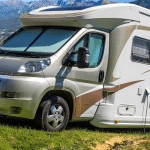


The licence you need to drive a motorhome in the UK depends entirely on its Maximum Authorised Mass (MAM). A standard Category B car licence covers motorhomes up to 3,500kg. Between 3,500kg and 7,500kg you need a Category C1 licence. Above 7,500kg you need a full Category C (HGV) licence. Drivers who passed their car test before 1 January 1997 automatically received C1 entitlement as part of their licence, but must complete a medical examination to keep it when renewing. Driving the wrong weight class is not just a motoring offence – it can invalidate your motorhome insurance entirely. See the official GOV.UK guidance on driving a motorhome for the authoritative DVLA position.
Key Terms
Maximum Authorised Mass (MAM) is the maximum legal weight of a vehicle when fully loaded, including fuel, water, passengers, and all luggage. It is also called Gross Vehicle Weight (GVW) or Gross Vehicle Mass (GVM). It is stamped on the vehicle’s VIN plate and shown in the V5C logbook. This figure, not the kerb weight or unladen weight, is what determines which licence category applies.
Category C1 is the DVLA licence entitlement required to drive vehicles between 3,500kg and 7,500kg MAM. It covers the majority of larger coach-built and A-class motorhomes. Category B is a standard car licence, covering vehicles up to 3,500kg MAM. Getting these categories wrong, even accidentally, is treated as driving without a valid licence and voids any insurance claim.
Quick Facts
- ✓Most motorhomes sold in the UK weigh between 3,000kg and 4,500kg MAM – a standard car licence only covers up to 3,500kg
- ✓Drivers who passed before 1 January 1997 have C1 entitlement automatically, but must provide a D4 medical form at age 45 and every renewal after 70
- ✓Renewing your licence online at age 70 removes your C1 entitlement – you must use D2 and D4 paper forms to keep it
- ✓UK speed limits for motorhomes over 3,050kg unladen are 50mph on single carriageways and 60mph on dual carriageways
Key Takeaways
- →Always check the MAM on your V5C logbook, not the kerb weight shown in a brochure – payload, water, and passengers all push the real weight above unladen figures
- →If you passed your test after 1 January 1997 and your motorhome is over 3,500kg MAM, you need a C1 licence before you drive it
- →Pre-1997 licence holders must complete a D4 medical to retain C1 entitlement – renewing online strips it from your licence automatically
- →Driving a motorhome on the wrong licence category invalidates your insurance and carries 6 penalty points plus an unlimited fine
- →Road tax for motorhomes is calculated differently depending on weight and registration date – vehicles over 3,500kg fall under the PHGV flat rate
Weight is the single most important number in motorhome ownership. It determines which licence you need, which speed limits apply, how your vehicle is taxed, and in many cases whether your insurance will pay out at all. Yet it is one of the most commonly misunderstood areas we see, particularly among first-time buyers who check a brochure kerb weight and assume their Category B licence will be sufficient.
This guide sets out the full picture clearly: the three licence categories, how grandfather rights work, the medical requirements that catch out older drivers, the speed limits that apply by weight class, road tax rules, and the direct link between all of this and your motorhome insurance policy. It is written for new buyers, upgraders, and anyone approaching 70 who needs to understand the renewal process.
Motorhome Licence Rules UK: A Summary
- Find the MAM on your V5C, not the brochure unladen weight. MAM is the legal maximum weight when fully loaded.
- Under 3,500kg MAM: a standard Category B car licence is sufficient, regardless of when you passed your test
- 3,500kg to 7,500kg MAM: Category C1 licence required. If you passed before 1997, you already have this – check the back of your photocard licence
- Over 7,500kg MAM: Category C (full HGV) licence required. This applies mainly to large American RVs and bus-chassis motorhomes
- Pre-1997 drivers must complete a D4 medical form to retain C1 entitlement at each renewal and at age 45+
- Post-1997 drivers needing C1 must apply for a provisional C1 via form D2, pass a D4 medical, and pass both theory and practical LGV tests
- At age 70, online licence renewal strips C1 entitlement. Use paper forms D2 and D4 to keep it. This catches many motorhome owners out every year.
Expert Note – MMC Insurance Specialists | FCA Reg. 916241
“The issue we see most often at renewal is pre-1997 licence holders who turn 70, renew their photocard online, and then continue driving a 4,500kg motorhome. They are doing so illegally. The online renewal system defaults to Category B only. It does not prompt you to include C1. The DVLA will not chase you – the responsibility is entirely yours. If you are in this group and you have already renewed online without a medical, you need to contact the DVLA immediately. Until C1 is reinstated, your motorhome insurance will not respond to a claim.”
What licence do I need to drive a motorhome in the UK?
The licence category required is determined by MAM (Maximum Authorised Mass), not physical size, engine size, or how the motorhome looks. MAM is the legal maximum the vehicle may weigh when fully loaded. It is found on the V5C and on the VIN compliance plate. Brochure weights and kerb weights are always lower – they do not account for payload.
| MAM (Max Authorised Mass) | Licence Required | Typical Motorhome Type | Pre-1997 Licence? |
|---|---|---|---|
| Up to 3,500kg | Category B (standard car licence) | Panel van conversions, compact low-profiles, smaller coach-builts (Swift Escape, Auto-Trail Tribute) | Yes – no additional entitlement needed |
| 3,501kg to 7,500kg | Category C1 | Most coach-builts, A-class motorhomes (Chausson, Burstner, Rapido, Dethleffs) | Yes – C1 included automatically. D4 medical required at renewal |
| Over 7,500kg | Category C (full HGV) | Large American RVs, bus-chassis motorhomes. Rare for private UK buyers | No – C is not included in pre-1997 Category B. Separate test required |
Always check your V5C, not the brochure. Manufacturers list unladen/kerb weight in sales literature. The V5C and VIN plate show the MAM. Add a full tank of fuel (~90kg), full fresh water (a 100-litre tank weighs 100kg), two passengers and luggage, and many motorhomes marketed as “under 3,500kg” sit very close to or above that threshold when loaded. If in doubt, weigh the vehicle at a public weighbridge before driving.
What are grandfather rights for motorhome licences?
Drivers who passed their standard car test before 1 January 1997 were automatically granted Category C1 entitlement on their licence. This is colloquially called “grandfather rights.” It means they can drive motorhomes up to 7,500kg MAM without taking an additional test, provided they meet the medical requirements and renew correctly. It does not extend to Category C vehicles over 7,500kg.
Before the EU Driving Licence Directive was implemented in the UK in 1997, a standard car licence permitted driving of heavier vehicles. When the rules changed, existing licence holders were given automatic C1 entitlement as a transitional right rather than being forced to retake tests. The entitlement is genuine and legal, but it comes with conditions that many drivers do not fully understand:
| Condition | What It Means | What Happens If You Ignore It |
|---|---|---|
| Age 45 medical requirement | From age 45, a D4 medical form completed by a GP must accompany your licence renewal to retain C1 | C1 entitlement is removed from your licence at renewal. You are then driving illegally on a Category B-only licence |
| Online renewal at age 70 | The DVLA online renewal system does not ask about C1. It defaults to Category B only | C1 is automatically stripped from your licence. You will not be informed. You must use D2 and D4 paper forms to keep it |
| Three-year renewal cycle after 70 | After age 70, licences must be renewed every 3 years. Each renewal requires a new D4 medical from a doctor | An expired licence means you are uninsured. The D4 medical costs approximately £80-£120 privately |
| C1 does not include C1+E (towing) | C1 alone permits towing a trailer up to 750kg only. To tow heavier, you need C1+E entitlement | Towing beyond your entitlement is an offence. It also invalidates both your motorhome insurance and any separate trailer policy |
How to Check Your Licence Entitlements
- →Check the back of your photocard driving licence for the categories listed. C1 will appear if you have the entitlement
- →Use the GOV.UK view your driving licence service to see all current entitlements online
- →If you hold an older paper licence only, your C1 entitlement will be listed on the front. You should exchange it for a photocard via the DVLA
- →If C1 is not listed and your motorhome is over 3,500kg MAM, you cannot drive it legally until you have passed the C1 test or regained the entitlement via the correct renewal process
How do I get a C1 licence to drive a motorhome?
If you passed your test after 1 January 1997 and want to drive a motorhome over 3,500kg MAM, you need to obtain Category C1 from scratch. The process involves a provisional application, a medical examination, an LGV theory test, and a C1 practical driving test. You must be at least 18 years old and hold a valid Category B licence.
| Step | What to Do | Cost / Notes |
|---|---|---|
| 1. Medical examination | Complete a D4 medical examination form with a GP or DVLA-approved medical practitioner. Covers vision, blood pressure, hearing, and general health | ~£80-£120 privately. Not available on NHS for DVLA purposes |
| 2. Apply for provisional C1 | Complete form D2 (application for a lorry, minibus or bus licence) and send with your D4 medical and current licence to the DVLA, Swansea SA99 1BT | No fee for adding provisional entitlement. Allow 2-4 weeks |
| 3. LGV theory test | Pass both sections: multiple choice and hazard perception. The LGV theory covers HGV-specific knowledge but a leisure-focused C1 test is not formally separated | £26 DVSA fee (2025) |
| 4. C1 practical driving test | Test conducted in a vehicle between 3,500kg and 7,500kg. You must arrange your own test vehicle – some specialist driving schools offer C1 motorhome training | £115 DVSA fee (2025). Training costs vary, typically £400-£700 all-in for specialist motorhome C1 courses |
| 5. Licence update | DVLA updates your photocard with C1 entitlement. You can now legally drive motorhomes up to 7,500kg MAM | C1 is then subject to medical renewal at 45 and every 3 years from age 70 |
What are the speed limits for motorhomes in the UK?
Motorhome speed limits depend on unladen weight, not MAM. Vehicles under 3,050kg unladen follow the same limits as cars. Motorhomes over 3,050kg unladen are subject to lower limits on single and dual carriageways. These are legal speed limits, not advisory figures. Exceeding them in a heavy motorhome is the same offence as speeding in any vehicle.
| Road Type | Under 3,050kg unladen | Over 3,050kg unladen |
|---|---|---|
| Built-up area (30mph zone) | 30 mph | 30 mph |
| Single carriageway (national speed limit) | 60 mph | 50 mph |
| Dual carriageway (national speed limit) | 70 mph | 60 mph |
| Motorway | 70 mph | 70 mph |
Note that the weight threshold for speed limits (3,050kg unladen) is different from the threshold for licence categories (3,500kg MAM). It is possible to hold a valid Category B licence for your motorhome and still be subject to lower speed limits if the unladen weight exceeds 3,050kg. Your owner’s manual and V5C will show the unladen weight separately from the MAM.
Pro Tip: The Speed Limit Trap
Many owners of coach-built motorhomes assume the 70mph motorway limit applies to them – and on the motorway, it does. The trap is on A-roads. A motorhome weighing over 3,050kg unladen is limited to 50mph on a single carriageway, not 60mph like a car. Fixed speed cameras on A-roads are calibrated to catch vehicles doing 60mph in a 50mph zone, and insurers treating speeding offences as material facts at renewal do not distinguish between car and motorhome limits. If you are unsure of your motorhome’s unladen weight, weigh it empty on a public weighbridge and note the figure.
How does motorhome weight affect insurance?
Driving without the correct licence for your motorhome’s weight class invalidates your insurance. This is not a technicality – it is a hard condition in every UK specialist motorhome policy. If you make a claim and the insurer discovers you were driving above your licence entitlement, the claim will be declined. You may also face personal liability for third-party damage.
Beyond the licence issue, weight also affects how insurers rate and price a motorhome insurance policy directly:
| Weight Factor | Impact on Insurance |
|---|---|
| Licence category match | Insurer will check your licence entitlement at claim. Category mismatch voids the policy entirely – no payout, possible personal liability |
| MAM and vehicle value | Heavier motorhomes are typically larger and more valuable. Higher replacement costs are factored into premiums and the sum insured |
| Overloading beyond MAM | Driving above your vehicle’s MAM is a legal offence independent of the insurance position. Insurers can also argue overloading contributed to an accident |
| Correct V5C body type | The V5C must show “motor caravan” for a specialist habitation policy to apply. Panel vans without this classification may be treated as commercial vehicles by the insurer |
| Agreed value vs market value | Heavier, more expensive motorhomes (typically A-class and over 4,500kg) benefit most from agreed value settlement – market value can leave a significant shortfall on total loss |
| Speed limit compliance | Speeding convictions for exceeding the lower limits that apply to heavy motorhomes are treated the same as any other conviction at renewal. Three points and a fine for 51mph on a single carriageway in a heavy motorhome is legally identical to any other speeding offence |
How is road tax calculated for motorhomes?
Motorhome road tax (Vehicle Excise Duty) is calculated differently from car tax. The rate depends on the motorhome’s revenue weight and registration date, not CO2 emissions alone. Motorhomes under 3,500kg revenue weight fall into the Private Light Goods (PLG) category; those over 3,500kg fall into the Private Heavy Goods Vehicle (PHGV) category with a flat annual rate. See the official GOV.UK motorhome road tax rates for current figures.
| Vehicle Category | Revenue Weight | How Taxed | Approx. Annual Rate (2025) |
|---|---|---|---|
| PLG (Private Light Goods) | 3,500kg or under | Engine size (TC10 tax class). Under 1,549cc or over 1,549cc bands apply | ~£180-£325 depending on engine size |
| PHGV (Private Heavy Goods) | Over 3,500kg | Flat rate (TC11 tax class) regardless of engine size or emissions | ~£290 flat rate per year |
| Historic vehicle (40+ years) | Any weight | VED exempt, but must apply annually and cannot be substantially modified | £0 (exempt) |
| M1SP (registered Apr 2017-Mar 2020) | Any weight | CO2 emissions-based, same system as a car. Affects some coach-builts from this period | Varies by emissions |
VED rates shown are approximate for 2025 and subject to change. Always check the current figures on GOV.UK before purchase or renewal.
What licence and class applies to each motorhome body type?
Different motorhome body types tend to fall into predictable weight ranges, but there is overlap. A long coach-built can weigh more than a short A-class. Always verify the specific vehicle’s MAM. The ranges below reflect typical UK market configurations, not absolutes.
| Body Type | Typical MAM Range | Licence Usually Needed | Examples |
|---|---|---|---|
| Panel van conversion | 2,800kg-3,500kg | Category B | VW California, Mercedes Marco Polo, Ford Transit-based conversions |
| Low-profile coach-built | 3,000kg-3,850kg | B or C1 (check MAM) | Swift Escape, Bessacarr, Adria Coral, Auto-Trail Tribute |
| Standard coach-built | 3,300kg-4,500kg | B or C1 (check MAM) | Bailey Autograph, Elddis Encore, Auto-Trail Frontier |
| A-class motorhome | 3,500kg-5,500kg | C1 (nearly always) | Burstner Elegance, Chausson Premium, Rapido 9, Hymer B-Class |
| American RV | 6,000kg-15,000kg+ | C1 or Category C depending on MAM | Tiffin Allegro, Winnebago, Monaco, Thor Motor Coach |
What is the difference between MAM, kerb weight, and payload?
These three figures are routinely confused in dealer listings and motorhome forums. Getting them wrong leads to drivers believing they are within their licence category when they are not. MAM is the only figure that determines licence requirements. Kerb weight and payload are relevant for loading management, not for determining which licence applies.
| Term | Definition | What It Is Used For | Where to Find It |
|---|---|---|---|
| MAM (Maximum Authorised Mass) | The legal maximum weight of the vehicle when fully loaded, as set by the manufacturer | Determines licence category, VED class, speed limits (indirectly), bridge restrictions | V5C logbook (section F), VIN plate on the vehicle chassis |
| Kerb weight (unladen weight) | The weight of the vehicle with a full fuel tank but no passengers, water, or luggage | Used to calculate payload. Also the threshold for speed limit purposes (3,050kg) | Owner’s manual, manufacturer spec sheet, dealer listing |
| Payload | MAM minus kerb weight. The maximum additional load the vehicle can legally carry (passengers, water, luggage, accessories) | Practical loading management. Many motorhomes have low payload figures – 300-600kg is common | Calculated from the above two figures |
| Revenue weight | DVLA’s term for the weight used to determine the VED tax class. Usually the same as MAM for motorhomes | VED (road tax) calculation. PLG vs PHGV distinction is based on this figure | V5C logbook |
Real Scenario: The 3,500kg Boundary
A coach-built motorhome listed with a 3,300kg kerb weight and 3,500kg MAM looks fine on a Category B licence. But load two adults (150kg), 80 litres of water (80kg), bikes on the rack (40kg), and luggage for a two-week trip (100kg), and the actual weight is 3,670kg – comfortably above the MAM. The vehicle is now being driven illegally, the insurer has grounds to decline any claim, and the driver would not know from the brochure weight alone that this was happening. The only way to know for certain is to weigh the vehicle at a public weighbridge while fully loaded, and to stay within the payload limit at all times.
Frequently Asked Questions
Important: Information, Not Advice
This article provides general information about UK motorhome driving licence categories, weight classifications, speed limits, and road tax rules. It does not constitute legal or regulated insurance advice. DVLA rules, DVSA test fees, and VED rates are subject to change. Always verify the current position with the DVLA directly at gov.uk/driving-motorhome before purchasing or driving a motorhome. MyMoneyComparison.com Ltd is authorised and regulated by the Financial Conduct Authority (FCA), registration number 916241.
Compare Motorhome Insurance Quotes
Once your licence is confirmed, make sure your cover is right. Compare specialist motorhome insurance from trusted UK providers. Free, no obligation.