

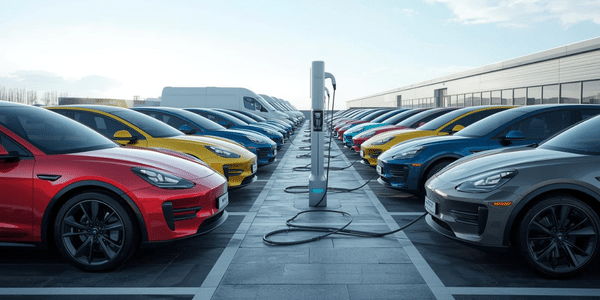


Electric vehicle fleet insurance is not simply standard fleet cover with a different vehicle type declared. EVs bring a distinct set of risks, components, and operational considerations that standard fleet policies were not designed around, and the gap between a policy that covers your EV fleet properly and one that doesn’t can run to tens of thousands of pounds in uninsured exposure. Battery replacement costs alone can exceed £15,000 per vehicle. Charging infrastructure liability, courtesy vehicle provision, and specialist repair requirements all create coverage questions that a standard fleet policy may answer inadequately.
The strategic context matters too. The UK’s Zero Emission Vehicle (ZEV) Mandate, which came into law in January 2024, requires 80% of new car sales and 70% of new van sales to be zero-emission by 2030, rising to 100% by 2035. For fleet operators, this isn’t a distant policy consideration, it’s a procurement reality that will reshape every renewal cycle between now and the end of the decade. Businesses that understand EV fleet insurance now will be better positioned as their fleets transition, rather than scrambling to arrange appropriate cover vehicle by vehicle as the deadline approaches.
This guide covers what EV fleet insurance must include that standard cover often misses, how premiums are calculated for electric vehicles, the specific questions to ask any insurer before binding cover, how mixed EV and ICE fleets are handled, and how the market is pricing EV risk as insurer confidence grows and the data improves.
Key Fact
The UK’s ZEV Mandate requires 80% of new car sales and 70% of new van sales to be zero-emission by 2030, with 100% by 2035. Fleet operators who begin transitioning now will have two to three policy cycles to build EV claims experience before the mandate makes ICE vehicle procurement significantly more restricted.
Why EV fleet insurance is different from standard fleet cover
Electric vehicles introduce several risk categories that simply don’t exist with petrol or diesel vehicles, and a standard fleet policy that doesn’t explicitly address them may leave you exposed. The core differences stem from four areas: battery value and replaceability, charging infrastructure, specialist repair requirements, and the higher average vehicle value of EVs relative to their ICE equivalents.
Battery risk is the most significant. A lithium-ion battery typically accounts for 30–50% of an EV’s total value. Replacement costs range from £5,000 for smaller battery packs to over £15,000 for premium or high-capacity models. Critically, even relatively minor physical damage to a battery casing can render the whole vehicle an economic write-off, because the risk of unseen internal damage makes repair commercially unviable. Insurers who lack confidence in battery assessment tend to write off EVs at higher rates, though this is improving as the market matures and assessment techniques improve. Your policy must explicitly cover the battery for accidental damage, fire, and theft. If your battery is leased separately to the vehicle (as some Nissan and Renault models allow), confirm your policy covers it regardless of the leasing arrangement.
Charging equipment creates new liability exposures. A Type 2 charging cable costs over £200 to replace. A workplace charging wallbox installation can run to £800–£1,500 per unit. These items are not covered under a standard fleet vehicle policy, they require either explicit inclusion or separate cover. There is also a public liability dimension: if an employee or member of the public trips over a charging cable while it is in use on a public street or car park, your business could face a personal injury claim. The best EV fleet policies include charging cable liability as standard; others exclude it entirely. Check the policy wording, not just the summary.
Repair times are longer, increasing courtesy vehicle costs. There is currently a shortage of technicians qualified to work on high-voltage EV systems in the UK. Specialist parts, particularly battery modules, electronic controllers, and EV-specific drive components, can take significantly longer to source than standard ICE parts. A repair that takes three days for a diesel van might take three weeks for its electric equivalent. For fleet operators, this means a like-for-like EV courtesy vehicle arrangement is critical. A standard diesel courtesy van is not an adequate substitute for a business whose drivers are configured to charge overnight and operate on electric-only routes. Confirm your policy guarantees an electric or hybrid replacement vehicle, not just “a courtesy vehicle.”
⚠ EV-specific cover gaps in standard fleet policies
- ✗ Battery cover excluded or limited to fire and theft only — accidental damage must be explicit
- ✗ Charging cables and wallboxes not covered — treated as non-vehicle equipment
- ✗ Courtesy vehicles provided as standard ICE rather than like-for-like EV or hybrid
- ✗ Roadside recovery doesn’t include tow to nearest chargepoint — vehicle abandoned if battery depleted
- ✗ Over-the-air software updates not covered — some policies exclude post-purchase performance upgrades
- ✗ Leased battery not covered — if the battery is on a separate lease agreement and isn’t explicitly included, it may be excluded
The ZEV Mandate: what it means for your fleet insurance planning
The Zero Emission Vehicle Mandate came into force in January 2024. It requires vehicle manufacturers to sell an increasing percentage of zero-emission vehicles each year: 28% of new cars and 16% of new vans in 2025, rising to 80% of cars and 70% of vans by 2030, and 100% by 2035. In April 2025 the government confirmed an end to new pure petrol and diesel car sales in 2030, with hybrid cars permitted until 2035 and ICE vans extended to 2035. The mandate targets manufacturers, not businesses directly, but its effects on fleet procurement are already being felt as ICE model availability begins to narrow and EV choice widens.
For fleet insurance, the ZEV Mandate creates both a timing pressure and an opportunity. The timing pressure is that businesses which wait until 2028 or 2029 to begin EV fleet transitions will be doing so in a compressed timeframe, with less flexibility on vehicle choice, charging infrastructure investment, and insurance arrangement. The opportunity is that insurers are actively improving their EV fleet products now, premium loadings have narrowed from 30%+ in 2023 to 10–20% in 2025–26, and the trend is continuing as claims data accumulates and repair networks expand. Businesses that transition earlier build EV claims experience sooner, which feeds into more competitive renewal pricing.
One practical implication for fleet insurance is that many businesses are currently operating mixed fleets, some ICE vehicles, some EVs, possibly some hybrids. Understanding how your insurer handles mixed fleet policies, and whether the policy wording treats all vehicle types consistently, is important before adding the first EV to an existing fleet policy. See the mixed fleet section below for specific guidance. You can also read more about mixed fleet insurance in our dedicated guide.
EV fleet vs ICE fleet: insurance cost comparison
The premium differential between EV and equivalent ICE fleet vehicles has narrowed considerably as insurer confidence grows and more claims data enters the market. The table below shows indicative 2025–26 market ranges for comparable EV and ICE vehicles across common fleet types, on comprehensive cover with experienced drivers.
| Vehicle Type | ICE Equivalent (per vehicle/yr) | EV Version (per vehicle/yr) | Loading | Primary Cost Driver |
|---|---|---|---|---|
| Small delivery van (e.g. e-Transit Custom vs Transit Custom) | £900–£1,300 | £1,050–£1,600 | 15–25% | Battery value, longer repair times |
| Company car (e.g. Tesla Model 3 vs BMW 3 Series) | £700–£1,100 | £850–£1,400 | 15–20% | High vehicle value, specialist repair |
| Large van (e.g. Ford e-Transit vs Ford Transit diesel) | £1,000–£1,500 | £1,200–£1,900 | 18–25% | Battery replacement cost, parts lead times |
| Budget EV (e.g. Nissan Leaf, VW ID.3) | £600–£950 | £650–£1,050 | 5–12% | Lower vehicle value narrows gap |
| Premium EV (e.g. Tesla Model S, Mercedes EQS) | £1,000–£1,600 | £1,300–£2,200 | 25–40% | Very high vehicle value, limited repair network |
Indicative 2025–26 market ranges, comprehensive cover, experienced drivers. Premium differentials are narrowing as insurer EV confidence grows. Always compare quotes, market pricing varies significantly by insurer.
What a proper EV fleet policy must include
When reviewing or procuring EV fleet cover, the headline premium is less important than the policy wording. Two policies at similar prices can deliver dramatically different levels of EV-specific protection depending on how the insurer has addressed the unique risks. These are the non-negotiable elements a solid EV fleet policy should contain.
Battery cover for accidental damage, fire, and theft. This should apply whether the battery is owned by the business or leased separately. Confirm coverage applies on a “new for old” basis for vehicles under 12 months old, and check whether the policy distinguishes between battery damage and battery degradation, normal wear and reduced range over time are excluded, but damage from an accident, fire, or electrical fault should be covered.
Charging cable and wallbox cover. Standard Type 2 charging cables cost £150–£300. Tethered home or workplace wallboxes can cost £500–£1,500 installed. Cover should include theft and accidental damage for cables used at home, at the workplace, and at public charging stations. Some policies limit this to cables attached to the vehicle; others cover cables stored in the vehicle or at the designated charge location. Read the territorial and usage conditions carefully.
Charging cable liability. If an employee’s charging cable, while in use in a public space, causes a trip or other injury to a third party, your business may face a public liability claim. Many standard fleet policies are silent on this. An EV-specific policy should explicitly include third-party liability arising from charging cable use, subject to a reasonable duty of care provision.
Recovery to the nearest chargepoint. Standard roadside breakdown, recovery to the nearest garage, is not useful if your driver runs out of charge on a route. EV-appropriate breakdown cover must include recovery to the nearest chargepoint, or provision of a mobile charge service where available. This is offered by specialist EV breakdown providers and should be bundled with or sit alongside your fleet policy.
Like-for-like EV courtesy vehicle. An EV off the road may be off the road for two to six weeks rather than two to six days due to specialist repair demand. A courtesy vehicle arrangement that provides a diesel van as substitute is operationally disruptive for businesses with electric-only operational models. Confirm in writing that your courtesy vehicle provision includes an electric or hybrid equivalent, subject to availability, with a named alternative arrangement if not.
Electric Vehicle Fleet Insurance
Make sure your EV fleet is covered for the risks that matter
Compare specialist EV fleet policies, battery cover, charging liability, and like-for-like courtesy vehicles included.
Insuring a mixed fleet: EVs and ICE vehicles on one policy
Most businesses transitioning to electric vehicles won’t replace their entire fleet simultaneously. The practical reality is a mixed fleet, some EVs, some petrol or diesel vehicles, possibly some plug-in hybrids (PHEVs), operating on a single policy. This is entirely achievable, but it requires care in how the policy is structured and what the insurer has explicitly agreed to cover for each vehicle type.
The principal risk in a mixed fleet policy is assuming that EV-specific cover terms apply uniformly to all vehicles. They don’t. Battery cover, charging equipment cover, and EV courtesy vehicle provisions typically attach to specific EV vehicles on the schedule, not to the policy as a whole. When you add a new EV to an existing fleet policy that was written primarily for ICE vehicles, confirm with your broker in writing that the EV-specific endorsements are applied to that vehicle from inception, not just assumed to be included.
Underwriters price mixed fleet policies by assessing vehicle risk individually and then applying a fleet weighting. A fleet of eight ICE vans and two EVs will typically be priced with the EVs at a slight premium to the ICE vehicles, but the overall fleet pricing should be more competitive than two separate policies. As your EV proportion grows, some insurers will transition you to a dedicated EV fleet product, often at better per-vehicle pricing, because the insurer can model the risk more consistently. Ask your broker at each renewal whether a specialist EV fleet product is now more appropriate than a mixed fleet arrangement.
Questions to ask before binding EV fleet cover
- ✓ Is the battery covered for accidental damage, fire, and theft — including if leased separately from the vehicle?
- ✓ Are charging cables covered for theft and accidental damage at home, at the workplace, and at public charging stations?
- ✓ Does the policy include public liability for charging cable accidents?
- ✓ Does breakdown cover include recovery to the nearest chargepoint, not just the nearest garage?
- ✓ Is courtesy vehicle provision guaranteed as electric or hybrid — not just “a vehicle of similar size”?
- ✓ Are approved repairers EV-qualified? Using a non-approved repairer may void your warranty and delay repairs by weeks.
- ✓ Does the policy cover over-the-air software updates and post-purchase performance upgrades declared at inception?
How EV fleet premiums are calculated
EV fleet premiums are assessed using the same fundamental framework as ICE fleet insurance, Confirmed Claims Experience (CCE), driver profiles, usage class, and vehicle value, with additional EV-specific weighting applied to battery value, repair complexity, and parts availability. Understanding these drivers helps you present your fleet most compellingly to underwriters.
Vehicle value is a bigger factor than with ICE equivalents. A Ford e-Transit Custom starts at around £42,000. Its diesel equivalent starts at around £30,000. The higher vehicle value directly increases the insurer’s total loss exposure and pulls up the premium. This effect is most pronounced for premium EV models, a Tesla Model S fleet will attract significantly higher premiums than an equivalent-purpose petrol fleet, purely on value grounds. Budget EVs like the Nissan Leaf or VW ID.3 narrow this gap considerably.
Repair network availability influences pricing region by region. An EV fleet operating in and around London, Manchester, or Birmingham benefits from a denser EV repair network and faster parts availability. The same fleet operating primarily in rural Wales or the Scottish Highlands faces longer recovery distances, fewer qualified technicians, and extended repair times, all of which increase claim costs and therefore premiums. Declare overnight storage and primary operational locations accurately; they matter more for EV fleets than for ICE fleets.
Telematics is particularly valuable for EV fleets. The regenerative braking and instant-torque characteristics of electric vehicles require a slightly different driving style to ICE vehicles. Telematics data that shows your drivers have adapted, smooth acceleration, effective use of regenerative braking, no harsh inputs, demonstrates lower accident risk and can support a meaningful premium reduction at renewal. For a new or transitioning EV fleet, fitting telematics from the outset is one of the most cost-effective investments you can make. Read more in our guide to fleet telematics and insurance costs.
EV fleet cover: what’s typically included vs excluded
The table below compares what specialist EV fleet policies typically include versus what standard fleet policies often exclude or leave ambiguous. Use this as a checklist when reviewing policy wording from your broker or insurer.
| Cover Element | Specialist EV Fleet Policy | Standard Fleet Policy | Risk if Missing |
|---|---|---|---|
| Battery — accidental damage | Included | Often excluded or limited | Up to £15,000+ uninsured per vehicle |
| Battery — leased separately | Included | Typically excluded | Total loss claim denied if battery not owned |
| Charging cables (home & public) | Included | Not covered | £150–£300 per cable replacement cost |
| Wallbox / home charger | Optional add-on | Not covered | £500–£1,500 replacement uninsured |
| Charging cable liability | Included | Silent / ambiguous | Personal injury claims undefended |
| Recovery to chargepoint | Included | Not included | Vehicle stranded; operational disruption |
| Like-for-like EV courtesy vehicle | Included (subject to availability) | ICE courtesy vehicle only | Operational disruption for EV-configured routes |
Reducing EV fleet insurance premiums
The EV premium loading over ICE equivalents is real but it is not fixed, and there are several practical steps that demonstrably reduce the gap. Insurers respond to evidence of risk management, and EV fleets that can demonstrate controlled operations consistently achieve better renewal pricing than those that cannot.
Choose lower-insurance-group EVs where operationally viable. Vehicle selection has a direct impact on fleet insurance premiums. A fleet of Nissan Leafs or Volkswagen ID.3s will cost significantly less to insure per vehicle than a fleet of Tesla Model Ys, even where drivers and usage are identical. If your operational requirement is primarily urban deliveries or local service routes rather than prestige travel, mid-range EVs offer substantial savings in both purchase price and insurance cost. This is one area where fleet managers can make a 15–25% premium difference through procurement decisions alone.
Invest in secure overnight charging. Vehicles charged and stored on private, secure premises overnight attract lower theft premiums than those left on public streets. Where drivers take EVs home to charge, consider whether a dedicated overnight parking arrangement, a lockable driveway, for example, can be declared to the insurer. This is particularly relevant for high-value EVs where theft risk commands a material premium uplift.
Implement EV-specific driver training. Some insurers offer premium reductions for fleets where drivers have completed structured EV orientation, covering regenerative braking, charging discipline, range management, and incident reporting procedures for EV-specific scenarios. This doesn’t require formal accreditation; a documented internal training programme delivered at vehicle handover, with a signed acknowledgement, may be sufficient. Ask your broker whether a specific training record format is preferred by the insurers on their panel. For a broader look at reducing fleet insurance costs, see our guide on how to reduce fleet insurance premiums.
✓ The EV fleet insurance premium outlook: reasons for optimism
- ✓ EV premium loadings have narrowed from 30%+ in 2023 to 10–20% in 2025–26 as insurer confidence improves
- ✓ EV repair networks are expanding — more qualified technicians and faster parts availability are reducing claim durations
- ✓ Data from Cap HPI shows proportionally fewer EVs are now written off than petrol and diesel cars — reducing total loss exposure
- ✓ Battery costs are falling as manufacturing scale increases, reducing the single largest EV insurance cost driver
- ✓ More insurers are entering the EV fleet market, increasing competition and improving product quality
Frequently Asked Questions
Is electric vehicle fleet insurance more expensive than standard fleet insurance?
Does my existing fleet policy cover EV batteries?
Can I put EVs and petrol or diesel vehicles on the same fleet policy?
What happens if one of my fleet EVs runs out of charge on a job?
Does fleet insurance cover workplace charging equipment?
How does the ZEV Mandate affect fleet insurance planning?
Fleet Insurance Comparison
Ready to insure your electric fleet properly?
Compare specialist EV fleet policies with battery cover, charging liability, and like-for-like courtesy vehicles, not just standard fleet cover with an EV box ticked.