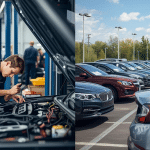


Road risk motor trade insurance covers you to drive vehicles in connection with your trade on public roads. It is the legal minimum. Combined motor trade insurance includes road risk but adds cover for your business premises, stock vehicles on site, customers’ vehicles in your care and custody, tools and equipment, and liability to employees and the public. Road risk only is appropriate for mobile traders and part-timers with no fixed premises. Combined is the right choice for any trader operating from a workshop, garage, showroom, or other fixed location where vehicles and equipment are held. For a broader introduction to how the policy works, see our guide to what motor trade insurance is.
Definitions
Road risk motor trade insurance is the minimum cover required by the Road Traffic Act 1988 for any motor trader who drives vehicles they do not own on public roads. It protects the trader (and named or any-driver policy holders) while driving customers’ vehicles, stock vehicles, and other trade vehicles on the road. It does not cover anything that happens to a vehicle while it is stationary at your premises.
Combined motor trade insurance is a single policy that builds road risk cover into a broader package covering the full range of risks a premises-based motor trade business faces: the property itself, stock held on site, customers’ vehicles left in your care, tools and equipment, and statutory and voluntary liability covers. It replaces the need for multiple separate policies and is almost always the right structure for any trader with a fixed business location.
Quick Facts
- ✓Road risk only covers vehicles while being driven – a customer’s car damaged overnight in your workshop is not covered by road risk
- ✓Employers’ liability insurance is a legal requirement under the Employers’ Liability (Compulsory Insurance) Act 1969 if you employ anyone – it is included in combined but not in road risk only
- ✓Stock vehicles left on your forecourt or in a compound overnight are not insured under road risk – they need material damage cover within a combined policy
- ✓A combined policy is typically 30-60% more expensive than road risk only, but replaces several separate policies that would cost significantly more individually
Key Takeaways
- →Road risk is a driving cover – it only responds when a vehicle in your trade possession is being driven on public roads
- →Combined motor trade insurance includes road risk plus premises, stock, care and custody, tools, and liability – in one policy, not several
- →If you have a physical premises, employees, or vehicles stored on site, road risk alone leaves you significantly exposed
- →Both policy types are available at three cover levels: third-party only, third-party fire and theft, and fully comprehensive
- →The right choice depends on your trade type, premises status, employee count, and the value of vehicles and equipment you hold
Road risk or combined is the single most consequential structural decision in motor trade insurance. Get it wrong and you are either over-paying for cover you do not need, or – far more commonly – operating with gaps that will only become apparent when a claim is refused. A mechanic who takes out road risk only, then stores a customer’s £35,000 Range Rover in his workshop overnight, is uninsured for that vehicle the moment it is not being driven. A dealer who takes out combined cover for a forecourt he never opens discovers at renewal that he has been paying for premises cover on an empty site for three years.
This guide explains both policy types in full, sets out exactly what each covers and what it does not, maps the right choice to different trade types with a worked example for each, and provides a direct cost comparison. For the mechanics of how motor trade insurance operates as an open policy, see our guide to how motor trade insurance works.
Road Risk vs Combined: The Core Differences at a Glance
- Road risk covers driving only. The moment the vehicle stops on your premises, road risk no longer responds to damage or theft.
- Combined covers the whole business. Premises, stock, customers’ vehicles in care, tools, equipment, and liability are all included in a single policy.
- Road risk is the legal minimum under the Road Traffic Act 1988. Combined exceeds the legal minimum but is commercially necessary for any premises-based trader.
- Employers’ liability is a legal requirement if you have staff and is only available within a combined policy or as a standalone add-on – it is not part of a road risk only contract.
- Both policy types apply the same three cover levels: third-party only (TPO), third-party fire and theft (TPFT), and fully comprehensive.
- Combined does not automatically mean comprehensive. A combined policy at TPFT level will not cover accidental damage to your stock or customers’ vehicles – you must choose comprehensive within the combined structure.
- The right policy is determined by your physical setup, not your trade type alone. A dealer working from home needs road risk. A dealer with a forecourt needs combined.
Expert Note – MMC Motor Trade Insurance Specialists | FCA Reg. 916241
“The claim scenario we see most often from road risk only holders is the overnight care and custody gap. A mechanic finishes a service on a customer’s car at 5pm, locks the workshop, and comes back in the morning to find it has been stolen. The road risk policy offers nothing – the car was not being driven. The customer then pursues the mechanic personally for the value of the vehicle. If you hold a single vehicle in your workshop overnight that you do not own, a combined policy is not optional – it is the only thing standing between you and a personal liability claim for the full replacement value of that vehicle.”
What does road risk motor trade insurance cover?
Road risk motor trade insurance covers the trader to drive any vehicle in their trade possession on public roads. This includes customers’ cars being test-driven after a service, stock vehicles being driven to auction or between sites, and vehicles being collected from or delivered to customers. Cover is active only while the vehicle is in motion on a public road – not while stationary at any location.
| Cover Element | Included in Road Risk? | Notes |
|---|---|---|
| Third-party liability (driving) | Yes – all levels | Injury to others and damage to third-party property while driving |
| Fire and theft of vehicle (driving) | TPFT and comprehensive only | Only while the vehicle is in trade possession. Not while stationary on site |
| Accidental damage to vehicle (driving) | Comprehensive only | Covers damage to the vehicle being driven in a road traffic incident |
| Business premises cover | No | Workshop, garage, showroom or office buildings are not covered by road risk |
| Stock vehicles on site | No | Vehicles held for sale and parked on site are not covered by road risk while stationary |
| Customers’ vehicles in care and custody | No – while stationary | A customer’s car parked in your workshop overnight is uninsured under road risk if it is damaged or stolen |
| Tools and equipment | No | Diagnostic equipment, ramps, jacks, and specialist tools require material damage cover in a combined policy |
| Public liability | No | Injury to a customer visiting your premises is not covered by road risk. Must be added separately or via combined |
| Employers’ liability | No | Legally required if you have staff. Not available within a road risk only structure |
| Social, domestic, and pleasure (SDP) use | Optional extension | Some road risk policies allow personal use of vehicles on the policy – must be declared and agreed at inception |
What does combined motor trade insurance cover?
Combined motor trade insurance includes everything in a road risk policy plus cover for the physical premises, all vehicles held on site whether stock or in customer care, tools and equipment, and the statutory and commercial liabilities that a premises-based motor trade business faces. It is not one policy bolted onto another – it is a single integrated contract that covers road and non-road risks under one schedule, one excess structure, and one renewal date.
| Cover Section | What It Protects | Key Conditions |
|---|---|---|
| Road risk | All vehicles in trade possession being driven on public roads | Same open-cover mechanism as a standalone road risk policy |
| Premises (material damage) | Workshop, showroom, garage buildings against fire, flood, storm, theft, and malicious damage | Sum insured must reflect full rebuild cost, not market value. Underinsurance applies |
| Stock cover | Vehicles held for sale, demo stock, and part-exchanges on site against damage and theft | Declared maximum stock value must reflect peak stock holding – typically adjusted in March and September for dealers |
| Customers’ vehicles in care and custody | Vehicles belonging to customers while in your care for repair, service, storage, or MOT | Cover responds whether the vehicle is being driven or is stationary on your premises |
| Tools and equipment | Specialist diagnostic equipment, workshop machinery, ramps, jacks, and hand tools | Tools must be declared. Limits often apply to tools in vehicles overnight; check policy for transit restrictions |
| Public liability | Claims by customers, visitors, or members of the public injured on your premises or as a result of your trade activity | Minimum £1 million limit; £2-5 million common for workshops and dealerships |
| Employers’ liability | Claims by employees for work-related injury or illness. Legally required under the Employers’ Liability (Compulsory Insurance) Act 1969 | Minimum £5 million cover required by law. Applies from the first employee, including part-time and apprentices |
| Business interruption (optional) | Lost income if an insured event (fire, flood, theft) prevents you trading for a period | Available as an extension. Indemnity period and loss of gross profit calculation must be set at inception |
| Sales and service indemnity (optional) | Claims arising from faulty workmanship, incorrect fitting of parts, or selling a vehicle with an undisclosed defect | Particularly relevant for garages, MOT centres, and dealers. Not standard in all combined policies – confirm at quote stage |
Road risk vs combined motor trade insurance: direct comparison
The table below maps every major risk area against both policy types. It is the clearest way to identify where a road risk only policy leaves gaps, and which gaps are commercially and legally significant enough to make combined cover the more appropriate choice.
| Risk / Cover Area | Road Risk Only | Combined |
|---|---|---|
| Third-party liability while driving | ✓ | ✓ |
| Fire and theft of vehicle being driven | TPFT+ | TPFT+ |
| Accidental damage to vehicle being driven | Comp only | Comp only |
| Customers’ vehicles – damage while driving | Comp only | Comp only |
| Customers’ vehicles – damage while stationary on site | ✗ | ✓ |
| Stock vehicles on site (fire, theft, damage) | ✗ | ✓ |
| Workshop / showroom / office buildings | ✗ | ✓ |
| Tools, diagnostic equipment, machinery | ✗ | ✓ |
| Public liability (customer/visitor injuries on site) | ✗ | ✓ |
| Employers’ liability (legal requirement if staff) | ✗ | ✓ |
| Business interruption cover | ✗ | Optional |
| Sales and service indemnity | ✗ | Optional |
✓ = included, ✗ = not included, TPFT+ = available at third-party fire and theft level and above, Comp only = available at comprehensive level only, Optional = available as a declared extension within the policy
What are the three cover levels available within road risk and combined policies?
Both road risk only and combined motor trade policies are available at three cover levels. The level determines how much protection you have within the policy structure you have chosen. A combined policy at TPO level, for example, will cover third-party liability on the road and premises, but will not pay out for damage to stock or customer vehicles. Choosing the right structure and the right level are two separate decisions.
| Cover Level | What It Covers | Who It Suits | Cost Position |
|---|---|---|---|
| Third-party only (TPO) | Injury to others and damage to third-party property only. Minimum legal requirement. | Part-time traders dealing in older, lower-value vehicles where self-insuring the vehicle is manageable | Lowest premium – but widest exposure if a claim arises |
| Third-party fire and theft (TPFT) | TPO plus fire damage and theft of vehicles in trade possession | Home traders and part-time dealers who drive stock between locations and need theft protection without comprehensive rates | Mid-range premium |
| Fully comprehensive | TPFT plus accidental damage to trade vehicles, customers’ vehicles, and stock. Most complete protection. | Any trader handling newer or higher-value vehicles, or with staff driving customers’ cars. The standard for most full-time operations | Highest premium – also the correct choice for most commercial operations |
Which policy type is right for my motor trade business?
The correct policy structure is determined by three factors: whether you have fixed business premises, whether you employ staff, and whether vehicles are stored on site when not being driven. If the answer to any of these is yes, a combined policy is the appropriate choice. Road risk only is correct only when all three answers are no.
| Trader Type | Correct Policy | Recommended Level | Key Risk If Wrong |
|---|---|---|---|
| Part-time home trader (buying and selling from home, no staff) | Road risk only | TPFT or comprehensive | Vehicles stored overnight at home are not covered while stationary unless the home address is declared as the business premises |
| Mobile mechanic (no fixed premises, works at customer sites) | Road risk only | Comprehensive | Tools in van are not covered by road risk – a tools-in-transit or tools and equipment extension is required |
| Sole trader mechanic or valeter with a workshop or unit | Combined | Comprehensive | Road risk only leaves customers’ vehicles, tools, and premises entirely uninsured |
| Used car dealer with forecourt or compound | Combined | Comprehensive | Stock vehicles on site overnight are entirely uninsured under road risk – a single theft event could be catastrophic |
| Franchised or independent car dealership with staff | Combined | Comprehensive | Employers’ liability is a legal requirement. Road risk only does not include it. Fine of up to £2,500 per day for non-compliance |
| MOT station or service centre | Combined | Comprehensive + sales and service indemnity | Public liability and employers’ liability gaps, plus no cover for specialist diagnostic equipment and ramps |
| Body repair shop or paint centre | Combined | Comprehensive + product liability extension | High-value customers’ vehicles in care throughout repair period. Road risk only leaves them uninsured when stationary |
How much more does combined cost than road risk only?
Combined motor trade insurance typically costs 30-60% more than an equivalent road risk only policy for the same trader. However, the comparison is not like-for-like: combined replaces what would otherwise be several separate policies. When the individual cost of premises cover, employers’ liability, public liability, and tools cover are added together, combined is almost always cheaper than building the same protection from standalone policies.
| Trader Profile | Road Risk Only (approx.) | Combined (approx.) | Separate Policies Alternative |
|---|---|---|---|
| Part-time home dealer, 1 driver, up to £30k stock | £350-£600/yr | N/A – road risk is correct | N/A |
| Sole trader mechanic, workshop, 1 employee | ~£600/yr (not sufficient) | £1,100-£1,600/yr | Road risk + EL + PL + tools = £1,600-£2,200/yr separately |
| Used dealer, forecourt, £150k stock, 2 staff | ~£900/yr (not sufficient) | £2,000-£3,500/yr | Individual policies combined would typically exceed £3,500-£5,000/yr |
| Independent garage, workshop, 4 technicians | ~£1,200/yr (not sufficient) | £3,500-£6,000/yr | Individual policies combined would typically exceed £6,000-£9,000/yr |
Premium ranges shown are approximate market indicators for 2025 and will vary significantly depending on drivers, claims history, vehicle values, stock levels, and individual insurer pricing. Always compare multiple quotes. See our motor trade insurance comparison page.
The Four Gap Scenarios Road Risk Only Does Not Cover
- 1.The overnight theft: a customer’s car or stock vehicle is stolen from your site at night. Road risk does not cover stationary vehicles. The customer or finance company pursues you personally for the full replacement value.
- 2.The workshop fire: a fire breaks out and destroys your workshop building, three customer cars awaiting service, and £12,000 of diagnostic equipment. Road risk covers none of it – not the building, not the customers’ cars, not the tools.
- 3.The employee injury: a technician slips on an oil spill on the workshop floor and breaks a wrist. Without employers’ liability insurance, the business is exposed to a personal injury claim with no cover and a potential HMRC fine for non-compliance.
- 4.The customer visit claim: a customer trips on a raised ramp in your workshop while collecting their vehicle and breaks their ankle. Public liability cover, absent from a road risk only policy, is the only protection against the compensation and legal costs that follow.
Frequently Asked Questions
Important: Information, Not Advice
This article provides general information about motor trade insurance policy structures in the UK. It does not constitute regulated insurance or financial advice. Policy terms, cover inclusions, exclusions, and pricing vary between insurers and depend on individual business circumstances. Premium ranges quoted are approximate market indicators only. Before purchasing any motor trade insurance policy, compare quotes from multiple providers and confirm the specific cover inclusions with the insurer or broker. MyMoneyComparison.com Ltd is authorised and regulated by the Financial Conduct Authority (FCA), registration number 916241.
Compare Motor Trade Insurance Quotes
Road risk or combined, TPO or comprehensive – compare policies from specialist UK motor trade insurers. Free, fast, and no obligation.



 Founder (2013)
 13+ Years
 FCA Regulated
 LinkedIn